
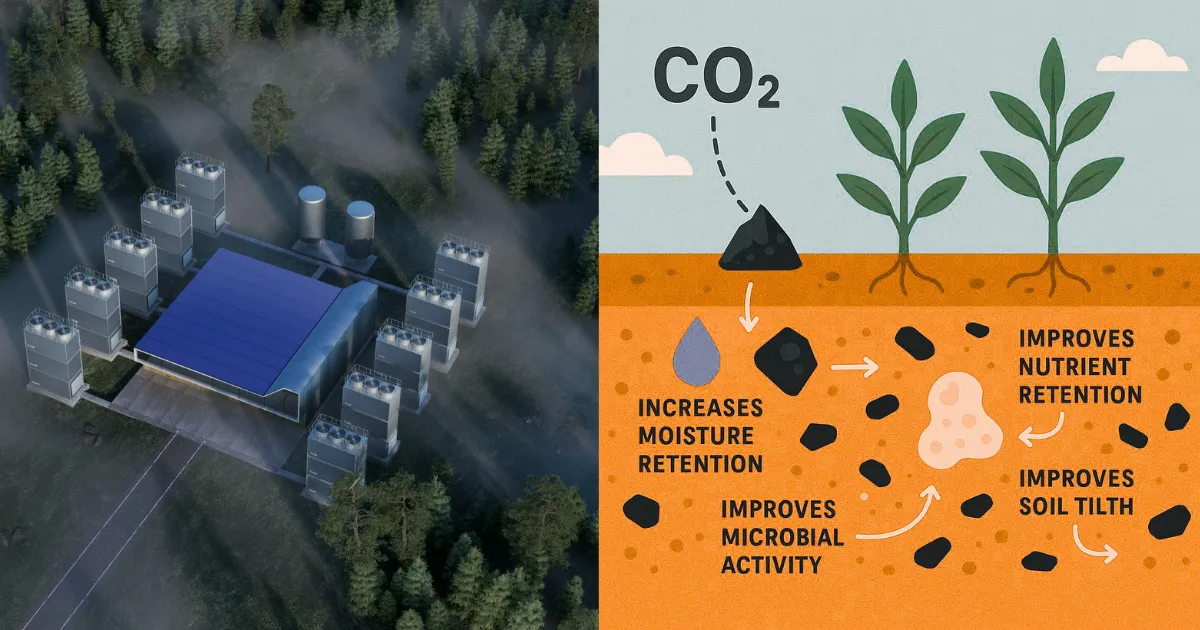
The 2030 climate deadlines are closing in fast. Predictably, the market's obsession with high-tech carbon removal has reached a fever pitch. Venture capitalists and corporate strategy directors, driven by mounting regulatory pressures, are pouring billions of dollars into mechanical Direct Air Capture (DAC) and traditional Carbon Capture and Storage (CCS) facilities.

But if you look closely at the techno-economic realities tracked by organizations like the Global CCS Institute, a massive bottleneck is hiding in plain sight. Mechanical DAC is fighting an uphill battle against both thermodynamics and capital efficiency. If we want gigaton-scale carbon removal by the end of the decade, we cannot rely solely on billion-dollar artificial vacuums.
There is a much more pragmatic, scalable, and economically viable alternative: Agricultural Direct Air Capture (AgDAC) via biochar.
If you are a climate tech investor, a corporate strategy director, or an energy analyst, understanding the operational differences between industrial CCS and Biochar DAC isn't just about saving the planet—it is about risk-adjusting your carbon portfolio and protecting your balance sheet.
The Thermodynamic Reality: The Energy Penalty of Mechanical DAC
At its core, mechanical Direct Air Capture is a fight against entropy. Carbon dioxide makes up roughly 0.04% of our atmosphere. Extracting it mechanically means pulling massive volumes of air through solvents, then applying intense thermal energy to release and compress that captured gas.
This process triggers what the industry calls the "Energy Penalty," a massive power requirement widely documented by the International Energy Agency (IEA).
Mechanical DAC facilities require an enormous, constant supply of zero-carbon energy. Building giant fan-based vacuums forces a zero-sum game on the grid: every megawatt of renewable energy you use to run a DAC plant is a megawatt that isn't decarbonizing the rest of the global economy.
Nature’s Operating System
Biochar DAC doesn't fight nature; it leverages it. Instead of building mechanical fans, it runs on "Nature's Operating System"—photosynthesis.
Plants already absorb atmospheric carbon using free, globally distributed solar energy. By taking agricultural crop residues that have naturally drawn down carbon, and stabilizing them into biochar through pyrolysis, we completely bypass the mechanical energy penalty.
The underlying math is simple:
{Total Efficiency} = {Carbon Captured}/{Energy Input}}
For mechanical DAC, the energy input denominator is astronomically high, which crushes overall efficiency. For Biochar DAC, the capture phase is powered locally by the sun, driving the denominator way down and making the system wildly efficient.
CapEx vs. OpEx: The Economics of Scaling by 2030
To hit the IPCC climate targets, carbon removal must scale exponentially, and fast. The single biggest threat to industrial CCS is its crippling Capital Expenditures (CapEx).
Building a mechanical DAC plant means sprawling industrial footprints, miles of pipeline, and billions of dollars in steel and concrete. These are macro-infrastructure projects. They take years to permit, finance, and build, trapping capital in illiquid, high-risk delays.
Biochar Direct Air Capture flips the script. It moves away from a centralized, CapEx-heavy infrastructure model and embraces a decentralized, Operational Expenditure (OpEx) driven approach.
Instead of building new billion-dollar facilities, AgDAC utilizes the world’s largest pre-existing infrastructure: the agricultural sector. Through models like Dynamic Carbon Credits, capital goes directly into deploying pyrolysis technology and incentivizing farmers. We leverage existing farm equipment, existing rural labor, and existing land. This allows operations to scale up in months, completely bypassing the construction delays and supply chain shortages that plague heavy industrial builds.
Solving The Land Dilemma
Land use is one of the tightest constraints in climate tech. Industrial DAC facilities, along with the massive solar or wind farms built specifically to power them, consume vast tracts of usable land. This pits decarbonization directly against land conservation.
Biochar eliminates this friction through dual-use integration.
Biochar isn't buried in a sterile carbon landfill. It is integrated directly into active agricultural soil. As officially recognized in the IPCC guidelines for greenhouse gas inventories, biochar definitively locks carbon away for thousands of years. But more importantly for the market, it acts as a "Yield Multiplier."
Biochar’s porous matrix acts like a microscopic sponge in the dirt. It holds onto water and traps costly fertilizers, keeping them at the root zone rather than letting them wash away. We aren't competing for land; we are actively upgrading its financial and agricultural output.
Why Smart Capital is Pivoting
For leaders managing Scope 3 emissions and corporate sustainability, the strategy is shifting. Buying legacy carbon offsets that fund distant, unverified avoidance projects is no longer enough. The pivot is moving toward agricultural insetting.
As Beau Parmenter notes, "We are at an inflection point where corporate climate capital must do more than just buy an abstract piece of paper to check a compliance box. By integrating biochar into active domestic farmlands, we aren't just offsetting emissions—we are permanently removing carbon from the atmosphere while actively drought-proofing the very supply chains these enterprises rely on."
Capital invested in Biochar DAC doesn't vanish. It circles right back into the domestic soils that actually produce an enterprise's raw materials, effectively fortifying the corporate supply chain from the ground up. You get a vastly superior CapEx-to-Output ratio, a lower cost per ton of permanent removal, and highly verifiable local economic growth.
Mechanical DAC will always have a place in the broader climate picture, but its thermodynamic limits and massive capital requirements make it inherently slow. If we are going to achieve gigaton-scale carbon removal by 2030, capital must back systems that work with planetary scale. Converting agricultural biomass into biochar is the ultimate arbitrage—combining free solar capture with engineered permanence to completely rebuild the foundation of our agricultural economy.