
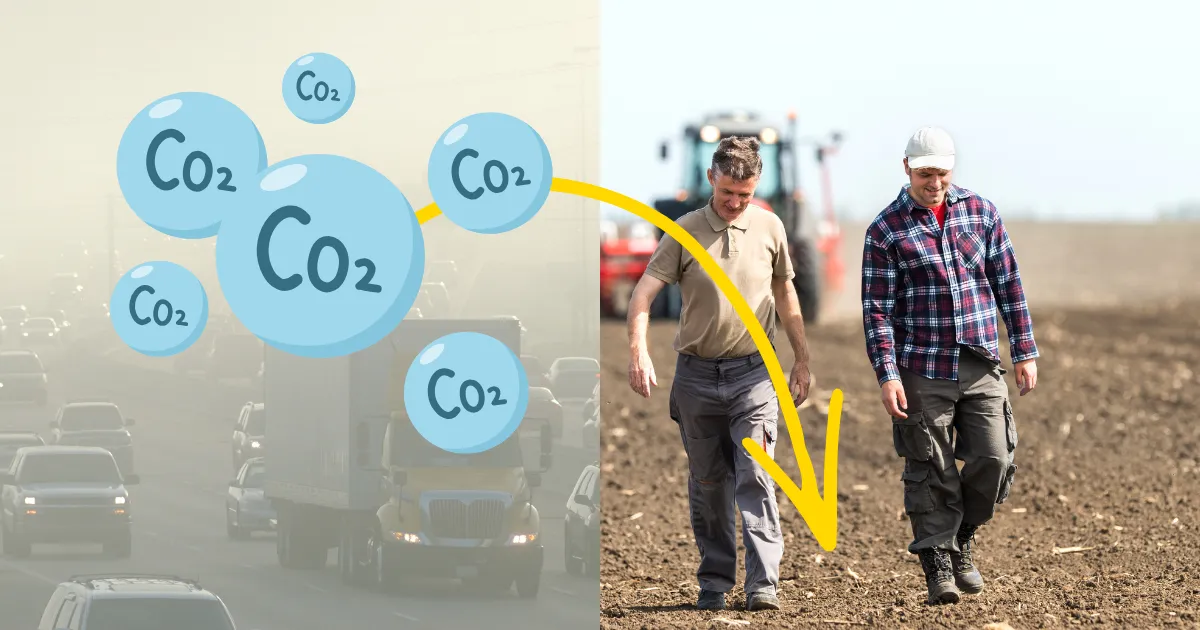
For Fortune 500 enterprises, the transition to absolute
For Fortune 500 enterprises, the transition to absolute climate compliance is no longer a distant theoretical goal; it is an immediate, daunting reality. Facing stringent new regulations like the SEC’s climate disclosure rules and the European Union’s Corporate Sustainability Reporting Directive (CSRD), corporate leaders are under immense pressure. Among the most complex operational and financial challenges they face is Scope 3 emissions mitigation.

Unlike Scope 1 (direct operations) and Scope 2 (purchased electricity), Scope 3 represents indirect emissions occurring deeply within a corporate value chain. For many large entities—especially in the food, beverage, apparel, and retail sectors—Scope 3 can account for 70% to 90% of their total carbon footprint. These emissions are notoriously difficult to track, incredibly complex to measure, and exceptionally expensive to eliminate.
Consequently, many Chief Financial Officers (CFOs) and Chief Sustainability Officers (CSOs) view Scope 3 compliance purely as a massive corporate liability—a multi-million-dollar tax on doing business in the 21st century. However, when paired with high-integrity, scientifically backed agricultural carbon credits, this liability transforms into an unprecedented socio-economic opportunity.
By consciously funding biochar production and regenerative agriculture, global corporations can effectively neutralize their massive supply chain emissions while simultaneously triggering localized, highly impactful rural revitalization.
The Scope 3 Solution: Insetting via Agricultural Carbon Credits
Scope 3 emissions predominantly originate at the very beginning of the supply chain: raw material extraction and agriculture. Historically, a corporation trying to offset the carbon footprint of its global supply chain might purchase cheap, unverified avoidance credits—essentially paying to protect a forest halfway across the world from being cut down. This approach is highly visible but practically disconnected from the corporation's actual physical footprint.
Today, sophisticated companies are abandoning the traditional offset model and looking toward "insetting." Insetting means solving the emissions puzzle directly within the specific agricultural sector the enterprise relies on. It is a targeted, local approach.
"We are moving away from the era where climate compliance is treated just like a carbon tax," explains Beau, Operations Lead at Dynamic Carbon Credits. "When you implement a proper Scope 3 emissions mitigation strategy through insetting, you are making a direct financial investment into the physical health of your own supply chain."
This is precisely where Dynamic Carbon Credits provides an elegant, scalable enterprise solution. Our proprietary agricultural direct air capture systems allow traditional row-crop farmers to actively draw down massive amounts of atmospheric carbon through the natural engine of crop photosynthesis. Post-harvest, this carbon-dense biomass is not left to decay and release secondary emissions; instead, it is synthesized into stable biochar, permanently locking the carbon away under our 60-Foot MAOC standard.
By purchasing these highly localized, verified agricultural carbon credits, corporations achieve verifiable Scope 3 emissions mitigation while directly supporting the physical industry sitting at the irreplaceable base of their supply chain.
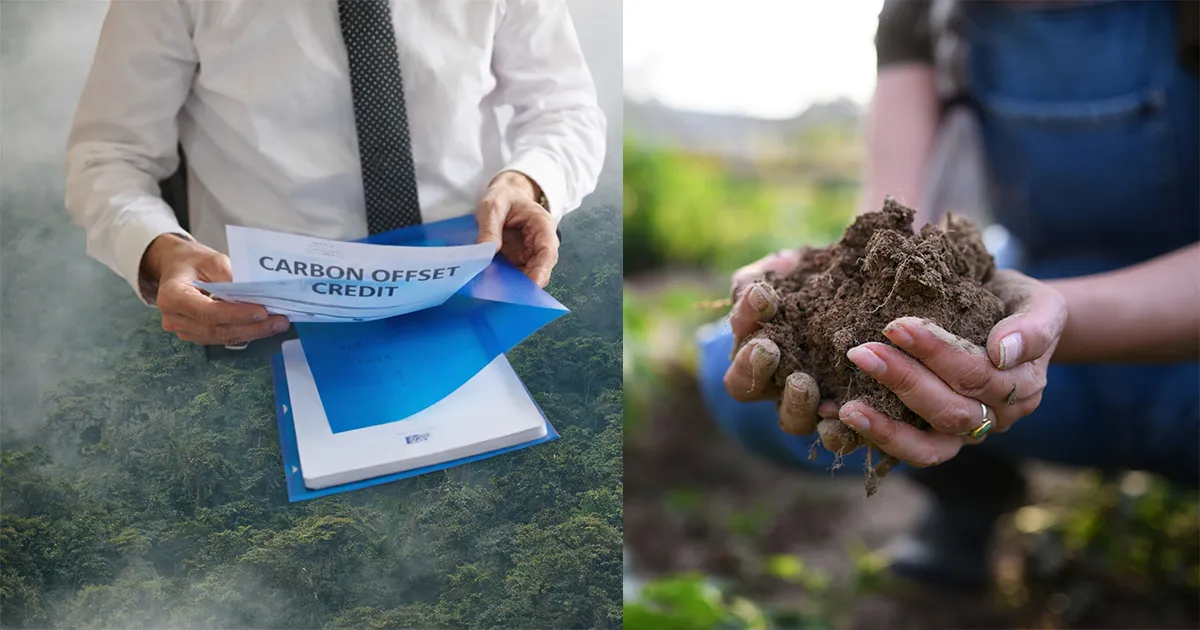
The strategic transition from traditional offsetting to agricultural insetting. Instead of purchasing static, paper-based avoidance credits disconnected from your operations (left), Dynamic Carbon Credits reinvest your compliance capital directly into the hands of local farmers—building rich soil and a resilient domestic supply chain (right).
Capital Transfer: Funding Rural Revitalization at Scale
A truly modern corporate ESG (Environmental, Social, and Governance) strategy requires fulfilling the "Social" and "Governance" components just as rigorously as the "Environmental." Investing in domestic agriculture hits all three pillars seamlessly.
Currently, thousands of rural farming communities face severe economic head-winds. Between soaring input costs for synthetic fertilizers, unpredictable global commodity markets, and shrinking crop margins, the modern family farm is under siege. Economic stagnation is a daily reality for rural producers.
When a Fortune 500 company allocates its mandatory climate compliance budget toward our agricultural direct air capture programs, it initiates a massive, highly efficient capital transfer. Instead of paying carbon taxes to regulatory bodies or buying credits from opaque international registries, that money is injected locally.
- Read our comprehensive guide to Regenerative Farming: Earn Up to $1,000/Acre
- This systemic capital transfer creates a highly lucrative secondary cash crop for agricultural producers out of thin air: verifiable carbon.
- By turning atmospheric carbon into a measurable asset class, corporate ESG funds bypass inefficient bureaucratic layers and go straight into the bank accounts of local farmers.
"When an enterprise buyer purchases one of our dynamic carbon credits, they are doing much more than erasing an environmental liability," Beau adds. "They are providing the exact financial runway a rural farmer needs to adopt better, more sustainable agronomic practices. That capital preserves generational family farms while scaling planetary climate technology. It is the ultimate win-win."
This direct, transparent capital injection acts as a powerful economic engine for rural revitalization, proving that big business and local agriculture can operate in a perfectly symbiotic economic loop.
The Yield Multiplier: Why Biochar for Farmers Changes Everything
The alignment of corporate liability mitigation and rural economic interests deepens significantly when examining the physical, agronomic impact of our technology. The biochar utilized to sequester corporate carbon does not just sit inertly in the ground like a buried waste product. It is an active agronomic enhancement.
At a microscopic level, biochar acts as a hyper-porous sponge beneath the soil surface. When integrated into the agricultural field, it fundamentally changes the soil mechanics. It drastically enhances soil water retention, ensuring moisture stays at the root zone rather than evaporating or running off. Furthermore, it tightly binds valuable liquid fertilizers (like nitrogen and phosphorus), preventing costly nutrient leaching into local watersheds.
For the farmer, this means healthier microbial ecosystems, reduced need for expensive synthetic inputs, higher crop yields, and vastly increased resilience against climate-induced drought events. The farmer produces more food at a lower operational cost, all while housing corporate carbon.

The Yield Multiplier in Action. A cross-section comparing standard agricultural soil (left) with biochar-enhanced soil (right). While standard soil suffers from nutrient leaching and poor moisture retention, the highly porous structure of biochar acts as a microscopic sponge. It locks in water and essential nutrients, promoting explosive root growth, drought resilience, and higher crop yields for the domestic supply chain.
Designing a Highly Resilient Global Supply Chain
Ultimately, driving effective Scope 3 emissions mitigation is not a charitable act for the enterprise; it is baseline corporate risk management. The climate crisis is already causing massive disruptions in raw material availability, driving up the cost of goods sold across every industry.
When you, as a corporate leader, invest in biochar for farmers through agricultural carbon credits, you are fundamentally protecting your own corporate supply chain. A farmer who is financially supported by corporate carbon credits and agronomically supported by highly fertile, biochar-enriched soil has a much greater capacity to predictably supply raw agricultural goods, regardless of shifting regional weather patterns.
In this profound economic symbiosis, the corporation successfully secures its hard-to-abate compliance mandates and protects its brand reputation, while the agricultural sector secures its financial viability and ecological future. The liability has officially become an asset.
Take the Next Step in Corporate Climate Leadership
Turn your looming climate liabilities into strategic, forward-thinking supply chain investments. By partnering with Dynamic Carbon Credits, you can confidently address your Scope 3 footprint while actively supporting the future of farming.
Action Step: Connect with our enterprise procurement team today to assess your Scope 3 footprint and explore securing your position in our upcoming corporate biochar portfolios.