
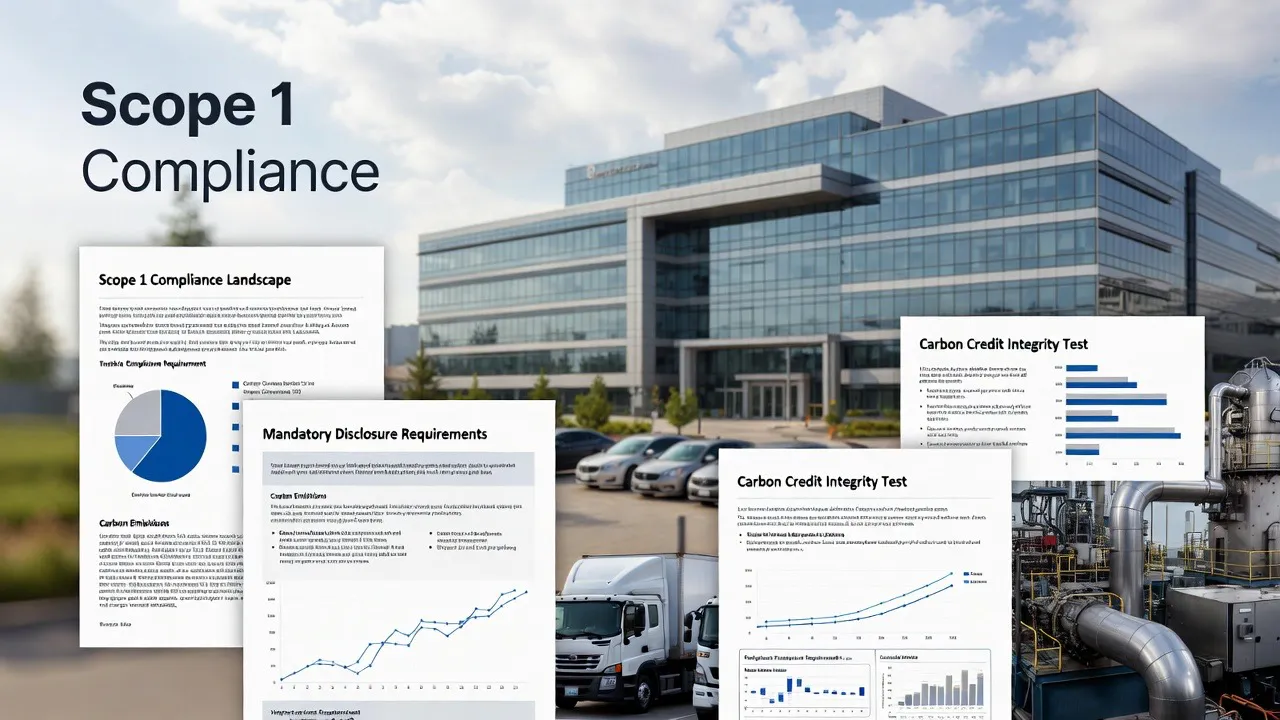
As Scope 1 emissions reporting requirements tighten under CSRD, California's SB 253, and emerging state regulations, corporate sustainability teams face mounting pressure to demonstrate genuine climate impact—not just compliance. The key differentiator? Additionality. This article explains why additionality is the cornerstone of carbon credit integrity, how to evaluate it during procurement, and why crop-based carbon removal offers the "clean additionality" that Fortune 500 sustainability programs increasingly demand.

The Scope 1 Compliance Landscape Is Shifting Fast
If you're leading sustainability at a Fortune 500 company, you already know: the days of voluntary climate commitments are giving way to mandatory disclosure. The regulatory landscape is transforming rapidly, and Scope 1 emissions sit squarely at the center.
Scope 1 emissions—the direct greenhouse gas emissions from sources your company owns or controls—now face unprecedented scrutiny. Whether it's your fleet vehicles, manufacturing processes, or on-site fuel combustion, these emissions represent the most tangible measure of your organization's carbon footprint.
The EU's Corporate Sustainability Reporting Directive (CSRD) mandates comprehensive sustainability disclosures, requiring detailed environmental data including Scope 1, 2, and 3 emissions. Large EU companies and non-EU companies with significant European operations began implementing these rules for their 2024 financial year, with disclosures published in 2025.
Meanwhile, California's Senate Bill 253 requires large corporations operating in the state—those with annual revenue exceeding $1 billion—to publicly disclose GHG emissions starting in 2026. New York, Colorado, New Jersey, and Illinois are considering similar legislation.
For sustainability leaders, this convergence of requirements creates both obligation and opportunity. The question is no longer whether to address Scope 1 emissions, but how to do so with credibility that withstands regulatory and stakeholder scrutiny.
Understanding Additionality: The Integrity Test for Carbon Credits
Here's where many corporate carbon strategies fail: they purchase credits without understanding whether those credits represent genuine atmospheric benefit. The concept that separates meaningful climate action from expensive greenwashing is additionality.
A carbon project is "additional" if its emission reductions or removals wouldn't have happened without the revenue from selling carbon credits. The Integrity Council for the Voluntary Carbon Market (ICVCM) defines it explicitly: "Greenhouse gas emission reductions or removals resulting from mitigation activity must be additional, i.e., they would not have occurred in the absence of the incentive created by carbon credit revenues."
Why does this matter so profoundly? Without additionality, the entire carbon credit mechanism becomes meaningless. If a project was already profitable—through selling electricity, receiving government subsidies, or simply being economically viable on its own—then purchasing credits from it doesn't create any new climate benefit. You've simply paid for something that would have happened anyway.
The Two Dimensions of Additionality
Financial Additionality: The project's financial viability hinges on the sale of carbon credits. Without this revenue stream, the project wouldn't be economically feasible.
Policy Additionality: The project goes beyond existing climate mitigation policies in its operating jurisdiction. If emission reductions are legally required, the project cannot be considered additional.
"Additionality is the single most important factor in evaluating carbon credit quality," notes our CEO, Beau Parmenter. "It's the difference between genuine carbon removal and expensive paperwork. At Dynamic Carbon Credits, we've built our entire model around eliminating any ambiguity on this question."
The Greenwashing Risk: What's at Stake
The OECD has raised significant concerns about greenwashing in voluntary carbon markets, emphasizing the need for governments to shape these markets toward greater integrity. For corporate sustainability teams, the risks of purchasing low-quality credits extend far beyond environmental impact.
Reputational Damage: Stakeholders—including investors, employees, and customers—are increasingly sophisticated about climate claims. Purchasing credits that lack genuine additionality invites criticism and erodes trust.
Regulatory Exposure: As disclosure requirements tighten, companies making sustainability claims based on questionable credits face potential legal and financial consequences.
Competitive Disadvantage: Organizations investing in high-quality carbon removal find themselves penalized when competitors make equivalent claims using inferior credits at lower cost.
Common greenwashing pitfalls include purchasing credits from projects that would have happened anyway, double-counting carbon credits across multiple parties, failing to prioritize in-house emission reductions, and investing in non-verified credits.
Evaluating Carbon Credits: The Additionality Checklist
As a VP of Sustainability who has evaluated countless carbon credit offerings, I've developed a practical framework for assessing additionality. Here are the questions your team should be asking:
What's the Baseline Scenario?
Understanding additionality requires comparing the project to a "business-as-usual" scenario. Would this activity have occurred without carbon credit revenue? If the answer is "probably yes," proceed with extreme caution.
Is the Project Certified by Recognized Standards?
The Verified Carbon Standard (VCS), managed by Verra, sets strict criteria for project design, monitoring, and verification. As of 2024, over 2,300 projects were registered under VCS, all required to demonstrate additionality. Gold Standard provides another reputable framework.
However, certification alone isn't sufficient. Rigorous due diligence at the project level remains essential to understand quality and risks.
What Barriers Did the Project Overcome?
Legitimate additional projects must overcome financial, technological, or other barriers that would prevent implementation under normal circumstances. If no such barriers exist, additionality is questionable.
Is This Practice Already Common in the Region?
If the project type is already being implemented regularly in a given geography without carbon credit support, it fails the "common practice" test. This is a red flag for additionality concerns.
Does the Project Exist Solely for Carbon Removal?
This is where Dynamic Carbon Credits' approach fundamentally differs from many alternatives. Our proprietary crop system—reaching 12-15 feet tall with root systems extending 33 feet deep over a 144-day lifecycle—exists solely for carbon sequestration. There is no alternative revenue stream, no dual purpose, no ambiguity. The additionality is inherent in the project design itself.
Clean Additionality: The Enterprise Standard
At Dynamic Carbon Credits, we use the term "clean additionality" to describe carbon removal that eliminates ambiguity entirely. This goes beyond meeting minimum certification requirements—it means structuring projects so that additionality cannot reasonably be questioned.
Our crop-based Biochar Agricultural Direct Air Capture (DAC-P) process exemplifies this approach:
Single Purpose: Our proprietary crops are grown exclusively for carbon sequestration. Unlike forestry projects that may have timber value or renewable energy projects that generate electricity revenue, our crops have one function: capturing atmospheric CO2.
Permanent Sequestration: Harvested biomass undergoes pyrolysis, converting it into stable biochar that persists in soil for centuries. This addresses permanence concerns that plague many nature-based solutions.
Multi-GHG Benefit: Beyond CO2 capture, biochar application actively mitigates methane and nitrous oxide emissions through its impact on soil characteristics—porosity, aggregation, moisture retention, and microbial communities.
Blockchain Verification: Every credit we generate carries transparent provenance from field to ledger, leveraging our partnership with Northern Trust's digital solution for institutional voluntary carbon credits.
Scope 1 Strategy: Prioritize Reduction, Then Remove
The OECD guidance is clear: companies should prioritize eliminating or reducing their own emissions, using carbon credits only as a last resort. This isn't merely regulatory advice—it's sound sustainability strategy.
For Scope 1 emissions specifically, your hierarchy should be:
- Eliminate: Can the emission source be removed entirely? Electrification of vehicle fleets, process redesign, and facility consolidation offer permanent solutions.
- Reduce: Where elimination isn't feasible, what efficiency improvements can minimize emissions? Energy management systems, equipment upgrades, and operational optimization deliver measurable reductions.
- Remove: For residual Scope 1 emissions that cannot be eliminated or reduced, high-quality carbon removal provides the path to genuine climate neutrality.
This third step—removal—is where additionality becomes critical. After investing in internal reductions, the last thing your sustainability program needs is to undermine that work with carbon credits that don't deliver real atmospheric benefit.
The Time Value of Carbon: Why Speed Matters
As Beau Parmenter frequently emphasizes, there's a "Time Value of Carbon" that many corporate strategies overlook. Carbon removed today has greater climate impact than carbon removed a decade from now. Similarly, verification that aligns with quarterly reporting cycles enables sustainability claims that match investor and regulatory timelines.
Traditional carbon credit projects often involve years of development, uncertain permanence, and verification delays that create gaps in corporate climate accounting. Our crop-based approach—with its 144-day lifecycle from planting to biochar production—delivers removal credits that synchronize with enterprise reporting requirements.
Preparing for the New Compliance Reality
As disclosure requirements multiply, sustainability teams should take immediate action:
Audit Current Credits: Review existing carbon credit holdings for additionality documentation. Can you demonstrate that each project meets recognized standards for financial and policy additionality?
Establish Procurement Criteria: Develop explicit requirements for carbon credit purchases that prioritize additionality, permanence, and verification transparency.
Engage Legal and Finance: Ensure cross-functional alignment on carbon credit accounting practices, particularly given evolving disclosure requirements under CSRD and state-level mandates.
Plan for Premium Credits: Budget for high-quality carbon removal credits. The market is bifurcating between commoditized, low-integrity credits and premium removal credits that deliver verified atmospheric benefit. Position your program on the right side of that divide.
Conclusion: Additionality Is Non-Negotiable
The voluntary carbon market is at an inflection point. Growing momentum around climate-related transparency, particularly concerning emissions and net-zero goals, is forcing organizations to substantiate their claims. For sustainability leaders navigating Scope 1 compliance, additionality has become the non-negotiable standard.
When evaluating carbon credits, remember: the question isn't just "Does this project reduce emissions?" The question is "Would these reductions have happened without our purchase?" Only credits that answer "no" to the second question deliver genuine climate benefit.
At Dynamic Carbon Credits, we've built our entire business model around that principle. Our crop-based carbon removal exists solely because of carbon credit demand—clean additionality by design, not by interpretation.
For Fortune 500 companies serious about Scope 1 emissions and sustainability leadership, that distinction matters more than ever.
Methods of Capturing Carbon
Feature
Mechanical CCUS/DAC
Dynamic Carbon Credits (DAC-P + Biochar)
Investment Risk
High (Billion-dollar CAPEX technical failures)
Low (distributed network, proven agricultural process)
Scalability
Slow, limited by large-scale engineering
Rapid, scalable across 800,000+ acres today
Co-Benefits
Few, energy-intensive process
High (soil health, water retention, methane reduction, rural economic support)
Permanence
High (geological storage)
High (verified multi-century storage as biochar)
Additionality
Dependent on project specifics
High (creates new, verifiable carbon sinks)
The Executive's Playbook for a Resilient Carbon Strategy
The carbon market of 2035 will reward those who make smart, de-risked decisions today. Relying solely on the promise of future, cheaper mechanical CCUS is a high-stakes gamble.
"Fortune 500 leaders are no longer just buying offsets; they are building resilient, diversified carbon removal portfolios," notes Beau Parmenter, a global commerce advisor. "The most intelligent strategies are those that lock in verifiable, high-integrity removal at a predictable cost. Solutions that combine permanence with tangible co-benefits for communities and ecosystems are setting the new standard for corporate leadership."
By integrating Dynamic Carbon Credits into your sustainability strategy, you are not merely offsetting emissions. You are investing in a cost-effective, scientifically validated, and permanent carbon removal solution that is available at scale now. Our rigorous, third-party verified chain of custody ensures every credit meets the highest standards of additionality and transparency, providing the assurance needed for credible ESG reporting.
The prediction is clear: the future of the voluntary carbon market belongs to solutions that are not only effective but also economically sound and environmentally holistic.
Take the next step toward a resilient and impactful sustainability strategy.
Offset your footprint now.