
- The world loses topsoil 10 times faster than nature can replenish it, threatening food security and corporate supply chains
- Regenerative agriculture improves soil health but lacks the permanence and speed corporate ESG timelines demand
- Crop-based biochar delivers permanent carbon removal, measurable greenhouse gas reductions, and soil regeneration within a single growing season
- The “Time Value of Carbon” explains why removing carbon now is more valuable than promises of future sequestration
- Dynamic Carbon Credits’ DAC-P process aligns regenerative agriculture with enterprise needs

Beau Parmenter
The Soil Crisis Threatening Corporate Supply Chains
Let me share a statistic that should concern every Chief Sustainability Officer: Soil scientists have warned that if current degradation rates continue, the world could lose its productive topsoil within 60 years—a projection first highlighted by researchers at the University of Sydney and referenced in United Nations World Soil Day communications
This isn’t hyperbole. It’s the scientific consensus from the FAO and leading soil scientists worldwide.
- The U.S. Midwest has lost an estimated 57.6 billion tons of topsoil since large-scale farming began
- Soil erosion costs approximately $300 billion annually worldwide
- Approximately 1.7 billion people already live in areas where crop yields are declining due to human-induced land degradation
- U.S. cropland soil erodes 10 times faster than it can be replenished
For Fortune 500 companies, this isn’t just an environmental concern—it’s a supply chain risk, a regulatory risk, and increasingly, a reputational risk. When your agricultural supply chain depends on soil that’s disappearing faster than it can regenerate, “business as usual” isn’t sustainable.
Regenerative agriculture offers a path forward. But as I’ll explain, traditional regenerative practices alone aren’t enough.
What Is Regenerative Agriculture?
Regenerative agriculture is a holistic, systems-thinking approach to farming that aims to improve and maintain the health of soil, water, biodiversity, and ecosystems while mitigating climate change.
Unlike conventional agriculture—which often depletes soil over time—regenerative agriculture actively restores soil health, sequesters carbon, and builds resilience into agricultural systems.
Core Principles of Regenerative Agriculture
The fundamental principles of regenerative agriculture include:
- Minimize soil disturbance through reduced or no-tillage practices
- Keep soil covered with living plants or residue year-round
- Maximize biodiversity through crop rotation and diversification
- Integrate livestock where appropriate
- Reduce or eliminate synthetic inputs like fertilizers and pesticides
Proven Benefits of Regenerative Agriculture
Research demonstrates that regenerative agriculture delivers measurable results:
- Soil organic carbon increases of up to 159%
- Crop yield improvements of up to 29%
- Enhanced water retention and drought resilience
- Improved biodiversity above and below ground
- Reduced input costs over time
These benefits explain why regenerative agriculture has moved from niche concept to mainstream corporate strategy.
Why Fortune 500 Companies Are Investing in Regenerative Agriculture
Regenerative agriculture is no longer a fringe movement. It’s becoming a core component of Fortune 500 sustainability strategies.
Market Growth
The global regenerative agriculture market is expected to reach $29.27 billion by 2033, with a compound annual growth rate exceeding 14%. This growth reflects corporate recognition that supply chain resilience depends on healthy soil.
Corporate Leaders in Regenerative Agriculture
Major corporations are setting aggressive regenerative agriculture targets:
This momentum demonstrates that regenerative agriculture has become a business imperative—not just an environmental aspiration.
Corporate Regenerative Agriculture Commitment
- ADM: Partnered with 28,000+ growers; enrolled 5 million regenerative acres globally in 2024 (achieved 2025 target early)
- Nestlé: Sourced 21.3% of key ingredients regeneratively in 2024; targeting 50% by 2030
- Ardent Mills: Aims to enroll 1 million acres in regenerative agriculture programs
- Danone: Significant supply chain investments in regenerative practices
- Unilever: Major commitments to regenerative agriculture across supply chains
- Diageo: Expanded regenerative farming for Guinness barley, whisky grains, and tequila agave
The Limitations of Traditional Regenerative Agriculture
Here’s where I must be direct with fellow executives: while traditional regenerative agriculture practices are valuable, they have significant limitations for corporate carbon strategies.
The Permanence Problem
Soil carbon accumulated through cover cropping, reduced tillage, and crop rotation is vulnerable. A single deep tillage event can release decades of accumulated carbon. Drought, fire, or management changes can reverse years of progress.
For corporations making net-zero commitments, this impermanence creates unacceptable risk. How do you report carbon sequestration that might not exist in five years?
The Timeline Problem
Traditional regenerative agriculture works slowly. Building soil organic matter takes years—sometimes decades—of consistent management. But corporate sustainability timelines don’t operate on agricultural timescales.
When your board sets a 2030 net-zero target, you need carbon removal solutions that deliver within your planning horizon. Waiting 15 years for soil carbon to accumulate isn’t a strategy—it’s a hope.
The Verification Problem
Soil carbon is notoriously difficult to measure and verify. Testing methodologies vary, results fluctuate seasonally, and establishing baselines requires years of data. This measurement uncertainty makes traditional soil carbon credits challenging for institutional buyers who require auditable, verifiable claims.
Understanding the Time Value of Carbon
This brings me to a concept central to how we approach regenerative agriculture at Dynamic Carbon Credits: the Time Value of Carbon.
Just as money has a time value—a dollar today is worth more than a dollar tomorrow—carbon removal has a time value. Removing carbon from the atmosphere now is more valuable than removing it later because:
- Cumulative Climate Impact
Every year carbon remains in the atmosphere, it contributes to warming. Earlier removal means less cumulative climate damage.
- Corporate Reporting Alignment
Companies report quarterly and annually. Carbon removal aligned with these cycles delivers reportable results within meaningful timeframes.
- Risk Reduction
Carbon removed and permanently sequestered today doesn’t face the reversal risks of carbon promised for future sequestration.
- Stakeholder Credibility
Investors, regulators, and customers increasingly demand demonstrated results—not projected outcomes.
Traditional regenerative agriculture, for all its benefits, doesn’t account for the Time Value of Carbon. It assumes we have decades to gradually build soil health. We don’t.
How Biochar Solves the Regenerative Agriculture Gap
This is why we built Dynamic Carbon Credits around crop-based biochar—and why I believe it represents the future of regenerative agriculture at enterprise scale.
What Is Biochar?
Biochar is a carbon-rich material produced through pyrolysis—the thermal decomposition of organic biomass in a low-oxygen environment. The result is a stable, porous material that locks carbon into molecular structures resistant to degradation for centuries.
Unlike soil organic carbon, which cycles relatively quickly through ecosystems, biochar carbon is chemically transformed into highly stable forms. This permanence is what distinguishes biochar from other regenerative agriculture carbon approaches.
Why Biochar Completes Regenerative Agriculture
Biochar doesn’t replace regenerative agriculture—it amplifies it. By combining regenerative principles with biochar’s permanence, we deliver:
- Permanent sequestration lasting centuries, not years
- Rapid results within a single growing season
- Verifiable outcomes through blockchain-enabled tracking
- Multiple co-benefits including greenhouse gas reduction and soil improvement
Our DAC-P Process: Regenerative Agriculture Engineered for Enterprise
At Dynamic Carbon Credits, we’ve developed a proprietary process called Direct Air Capture through Photosynthesis (DAC-P) that combines regenerative agriculture principles with enterprise-grade permanence and verification.
Stage 1: Capture
Our proprietary crop—a fast-growing, high-biomass plant reaching 12-15 feet tall with a root system extending 33 feet deep and 12 feet wide—captures atmospheric CO₂ through natural photosynthesis.
This isn’t emissions avoidance; it’s true carbon removal from air that already exists. The 144-day growth cycle means measurable carbon capture within a single quarter—aligned with corporate reporting timelines.
Stage 2: Sequester
Harvested biomass undergoes controlled pyrolysis, transforming organic carbon into stable biochar. This thermochemical conversion locks carbon into structures that persist for centuries, not years.
Stage 3: Regenerate
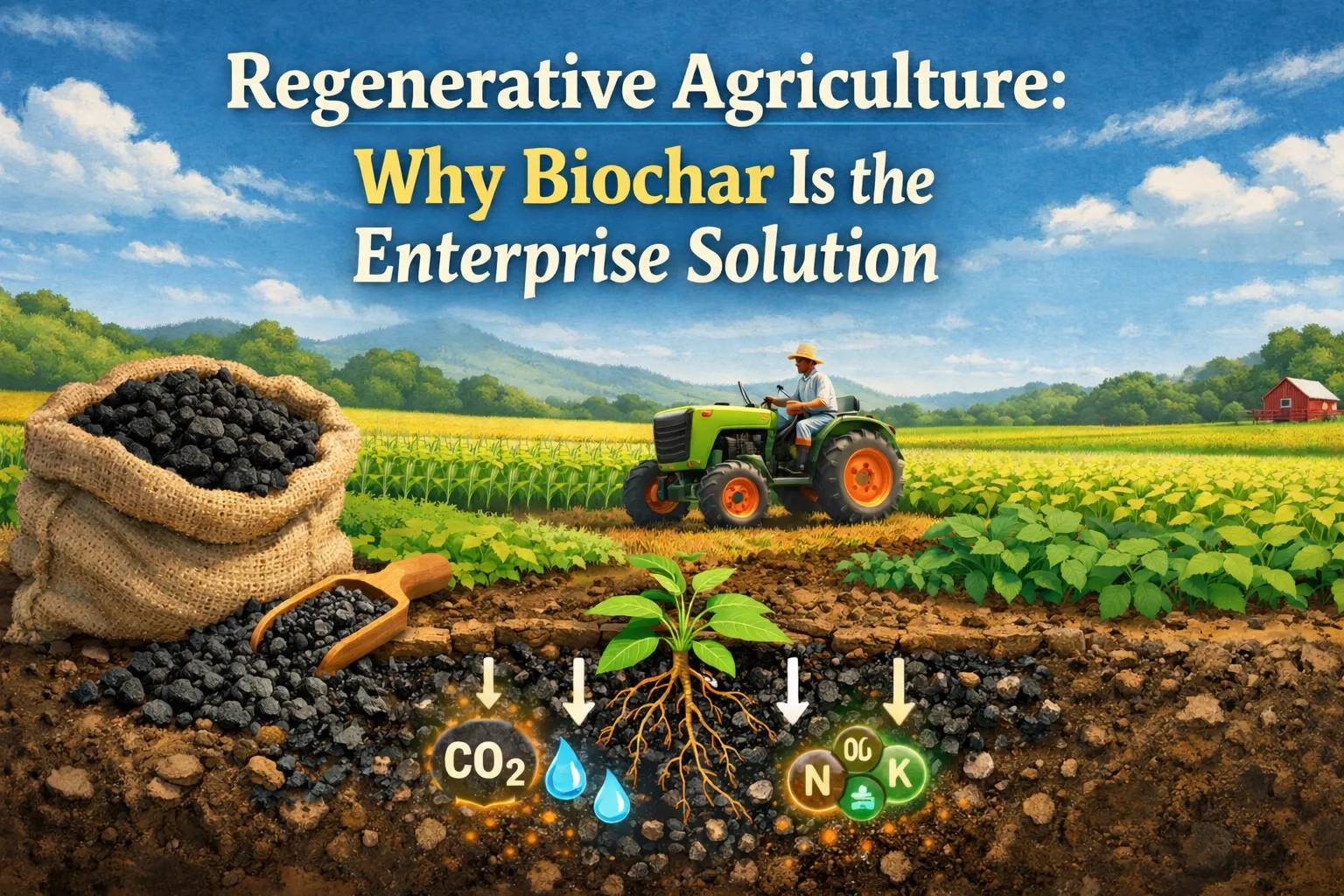
Biochar returns to agricultural soil, delivering compounding regenerative agriculture benefits:
- Improved soil structure and water retention
- Enhanced nutrient availability including nitrogen, phosphorus, potassium, calcium, and magnesium
- Reduced methane emissions through improved soil aeration that promotes methane-oxidizing microorganisms while suppressing methane-producing archaea
- Decreased nitrous oxide emissions, particularly in loam and clay soils
- Boosted microbial activity through biochar’s porous architecture
Stage 4: Verify
Northern Trust’s digital solution for institutional voluntary carbon credits provides blockchain-enabled verification from field to ledger. This institutional-grade transparency meets Fortune 500 standards and aligns with OECD recommendations for combating greenwashing.
The Regenerative Multiplier Effect
What excites me most about crop-based biochar is that it creates what I call the “regenerative multiplier effect”—amplifying every benefit of regenerative agriculture.
- Accelerated Soil Biology
Biochar’s porous structure provides habitat for beneficial microorganisms, accelerating the biological processes that make regenerative agriculture work. Research shows biochar amendments significantly boost microbial activity and nutrient cycling.
- Enhanced Water Management
Biochar improves soil’s water-holding capacity, making regenerative agriculture systems more resilient to drought—increasingly critical as climate volatility intensifies.
- Reduced Input Dependency
By improving nutrient availability and retention, biochar reduces reliance on synthetic fertilizers—a core regenerative agriculture principle. Progressive mineralization releases nutrients into soil over time.
- Greenhouse Gas Reduction
Beyond carbon sequestration, biochar actively reduces methane and nitrous oxide emissions from agricultural soils. Studies show reductions of 8.6-89.6% for CH₄ and 10-90% for N₂O depending on application rates and soil types.
- Permanent Carbon Foundation
While traditional regenerative agriculture builds soil organic matter gradually, biochar establishes a permanent carbon foundation that won’t reverse with management changes or climate events.
What This Means for Corporate Sustainability Leaders
If you’re a Chief Sustainability Officer navigating regenerative agriculture investments, here’s what you need to understand:
The Market Is Differentiating
Not all carbon credits are equal. The voluntary carbon market increasingly distinguishes between emissions avoidance credits and removal credits. Crop-based biochar delivers true carbon removal—a premium asset class with greater credibility.
Speed Matters
Your stakeholders expect results within meaningful timeframes. A 144-day crop cycle aligned with quarterly reporting delivers demonstrable progress, not distant promises.
Permanence Is Non-Negotiable
As carbon market scrutiny intensifies, credits backed by permanent sequestration will hold value while reversible credits face discounting. Biochar’s centuries-long stability provides the durability institutional buyers require.
Co-Benefits Create Value
Regenerative agriculture combined with biochar delivers multiple value streams: carbon removal, greenhouse gas reduction, soil improvement, and agricultural productivity gains. This is strategic investment, not commodity offset purchasing.
Verification Builds Trust
Northern Trust’s blockchain-enabled verification provides transparency that combats greenwashing concerns. Institutional-grade verification is a competitive advantage.
Frequently Asked Questions About Regenerative Agriculture and Biochar
What is regenerative agriculture?
Regenerative agriculture is a holistic farming approach that focuses on restoring soil health, increasing biodiversity, enhancing water cycles, and sequestering carbon. Unlike conventional agriculture, which can deplete soil over time, regenerative agriculture actively improves the land while producing food.
How does biochar support regenerative agriculture?
Biochar amplifies regenerative agriculture by providing permanent carbon storage, improving soil structure and water retention, enhancing nutrient availability, and creating habitat for beneficial soil microorganisms. It delivers the permanence and speed that traditional regenerative practices lack.
Why is regenerative agriculture important for corporations?
Regenerative agriculture addresses supply chain resilience, carbon reduction commitments, and stakeholder expectations. As soil degradation threatens global food production, companies investing in regenerative agriculture protect their supply chains while advancing sustainability goals.
How long does biochar carbon sequestration last?
Biochar sequesters carbon for centuries. Unlike soil organic carbon accumulated through traditional regenerative agriculture—which can be released through tillage or land use changes—biochar’s stable molecular structure resists degradation for hundreds of years.
What is the Time Value of Carbon?
The Time Value of Carbon recognizes that removing carbon from the atmosphere now is more valuable than removing it later. Earlier removal reduces cumulative climate impact, aligns with corporate reporting cycles, and eliminates reversal risk.
How does Dynamic Carbon Credits verify its regenerative agriculture carbon removal?
We use Northern Trust’s digital solution for institutional voluntary carbon credits, providing blockchain-enabled verification from field to ledger. This institutional-grade transparency meets Fortune 500 standards and aligns with OECD recommendations.
Regenerative Agriculture for the Enterprise Era
Regenerative agriculture represents one of the most important shifts in how we think about food, farming, and corporate sustainability. But traditional regenerative practices alone cannot deliver the speed, permanence, and verification that Fortune 500 companies require.
Crop-based biochar bridges this gap—combining regenerative agriculture’s soil health benefits with enterprise-grade permanence, rapid timelines, and institutional verification.
The Time Value of Carbon demands we act now. The soil beneath our feet depends on it. And so does the credibility of our climate commitments.
At Dynamic Carbon Credits, we’re building the future of regenerative agriculture—engineered for enterprise needs. Our proprietary DAC-P process delivers measurable carbon removal within a single growing season, permanent sequestration verified through blockchain technology, and soil regeneration that compounds over time.
The question isn’t whether regenerative agriculture will shape corporate sustainability—it already is. The question is whether your organization will settle for incremental progress or embrace solutions that match the urgency of this moment.