Not all carbon credits are created equal. As corporate buyers navigate an increasingly complex market, understanding the fundamental difference between removal credits and avoidance credits has become essential. It is important to buy carbon credits strategically—prioritizing quality, permanence, and genuine climate impact over price-per-ton metrics that can mask significant differences in value.

If your company is preparing to purchase carbon credits, you're entering a market undergoing rapid transformation. After years of volume-based trading and speculative activity, the voluntary carbon market is now emphasizing integrity, quality, and long-term value. Buyers are increasingly focused on ensuring their investments drive real climate benefit—particularly after reports of some carbon projects underdelivering on their promises.
The Carbon Credit Market Has Changed
This shift creates both challenge and opportunity for corporate procurement teams. The challenge: navigating a market where credit quality varies dramatically. The opportunity: positioning your organization as a climate leader by investing in carbon removal that delivers genuine atmospheric benefit.
As our CEO, Beau Parmenter, often notes:
"The carbon credit market is bifurcating. Companies can choose between commoditized credits with questionable impact, or premium removal credits that represent true atmospheric benefit. That choice will define climate leaders from laggards."
Understanding the Fundamental Distinction: Removal vs. Avoidance
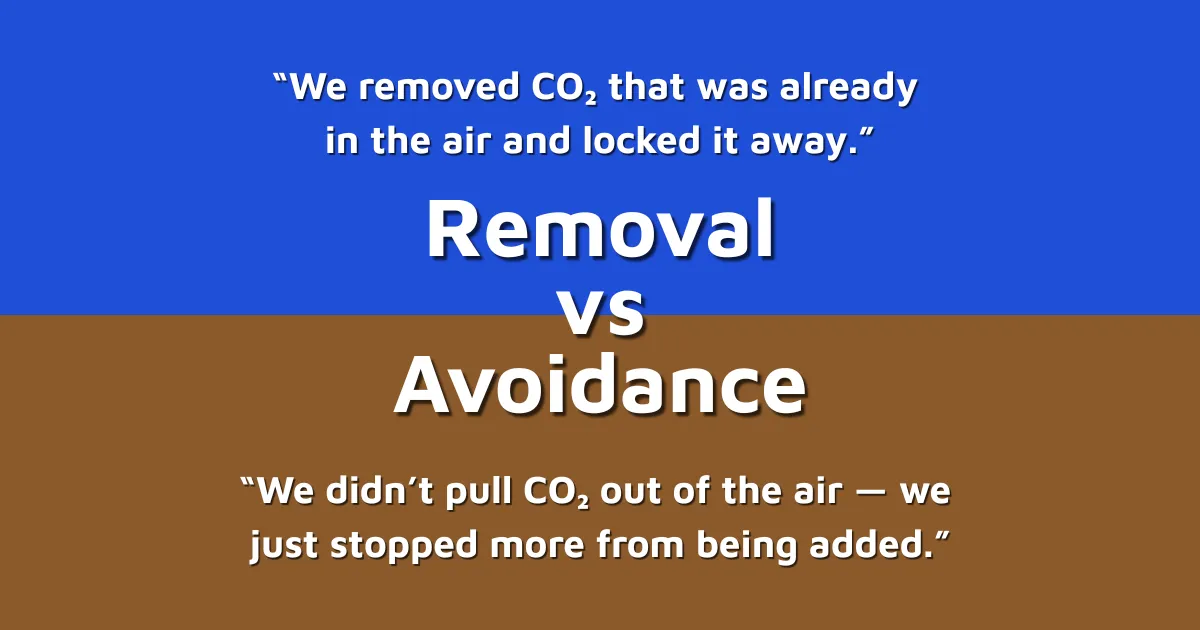
Before purchasing a single credit, your team must understand the most important distinction in the carbon market: the difference between carbon removal and carbon avoidance.
Carbon Avoidance Credits
Avoidance credits represent projects that prevent the release of additional greenhouse gases into the atmosphere. Think of it like turning down the tap on water filling a bathtub—you're slowing the flow, but not draining what's already there.
Common avoidance projects include:
- Renewable energy installations (wind, solar)
- Forest protection (preventing deforestation)
- Methane capture from landfills
- Energy efficiency improvements
Avoidance credits serve an important function: they slow the pace of climate change and safeguard existing carbon sinks. However, concerns exist around whether avoidance projects provide truly additional environmental benefits. Credibility depends on robust baselines, clear additionality, and transparent monitoring—and some projects may overstate their impact.
Carbon Removal Credits
Removal credits represent projects that directly extract CO2 from the atmosphere. Using the bathtub analogy, removal is like pulling the plug to drain water that's already accumulated.
Removal approaches include:
- Direct air capture and storage (DACS)
- Reforestation and afforestation
- Biochar production and soil carbon sequestration
- Enhanced weathering
- Ocean-based carbon removal
Carbon removal is crucial for long-term goals like reaching net-zero emissions and addressing the stock of existing atmospheric carbon. It's essential for counteracting humanity's cumulative impact on global emissions.
Why This Distinction Matters for Procurement
Here's the critical insight: both avoidance and removal play roles in climate mitigation, but they serve fundamentally different purposes. Avoidance buys time; removal solves the long-term problem.
The market increasingly recognizes this distinction. In 2024, credits from forest projects that remove carbon were consistently priced two to four times higher than credits from forest projects focused on avoidance. Nature-based carbon removals increased by approximately 50% between 2023 and 2024, and the durable carbon dioxide removal (CDR) market more than doubled in size in Q2 2025.
For Fortune 500 companies making net-zero commitments, removal credits offer something avoidance credits cannot: the ability to claim genuine atmospheric carbon reduction, not merely prevented emissions.
How to Buy Carbon Credits: A Step-by-Step Framework
Step 1: Define Your Climate Goals and Scope
Begin by clearly articulating what emissions you intend to address. Are you targeting Scope 1 direct emissions? Scope 2 purchased energy? The more challenging Scope 3 value chain emissions?
Some organizations start with Scopes 1 and 2, while others pursue comprehensive coverage aligned with net-zero targets. Your answer shapes everything that follows—the volume of credits needed, the types most appropriate, and the timeline for procurement.
Key questions to answer:
- How many tons of CO2 equivalent do you need to address?
- Over what timeframe?
- For which business units or emission categories?
Step 2: Establish Your Quality Criteria
The carbon market offers credits at vastly different price points—and quality levels. Establishing rigorous criteria before engaging suppliers prevents costly mistakes.
Essential quality markers include:
Additionality: Would this carbon reduction have occurred without carbon credit revenue? This is the foundational integrity test. Projects that would have happened anyway—due to regulatory requirements, economic viability, or existing incentives—fail to deliver genuine climate benefit.
Permanence: How long will the carbon remain sequestered? Biochar, for example, can persist in soil for centuries, while some forestry projects face reversal risks from fire, disease, or land-use changes.
Verification: Is the project certified by recognized standards? Prioritize credits verified by reputable third-party standard setters including Verra (VCS), Gold Standard, American Carbon Registry, and Climate Action Reserve.
Transparency: Can you access detailed project documentation? Ensure project data is accessible and credible.
Step 3: Understand Verification Standards and Registries
The Integrity Council for the Voluntary Carbon Market (ICVCM) and its Core Carbon Principles (CCPs) have established a foundational framework for integrity in the voluntary carbon market. Use these principles as a baseline for evaluation.
Major registries to consider:
- Verra (VCS): The most widely used standard, with strict criteria for project design, monitoring, and verification
- Gold Standard: Strong emphasis on sustainable development co-benefits
- American Carbon Registry: Rigorous methodology development
- Climate Action Reserve: North American focus with robust protocols
Also monitor emerging guidelines from organizations like the Voluntary Carbon Markets Integrity Initiative (VCMI), which addresses how companies should use and claim credits.
Step 4: Conduct Rigorous Due Diligence
Due diligence processes for carbon credit procurement are necessarily intensive. Buyers need clarity on the financials behind each project, including how much of the investment goes directly to the project versus intermediaries.
Questions to ask before purchasing:
- Which certification standard governs this project?
- Is this an avoidance or removal credit?
- How recently did the emission reductions or removals occur?
- What is the price per ton, and what factors contribute to it?
- Does the project align with our company's values and strategy?
- What permanence safeguards are in place?
- How is additionality demonstrated?
Step 5: Consider Your Procurement Strategy
Corporate buyers have multiple options for acquiring carbon credits:
Spot Purchases: Offer instant offset claims, no delivery risk, and market agility. However, they may face limited availability of quality credits and price uncertainty.
Long-Term Contracts (Offtake Agreements): Provide stability, potential savings, and supply security. They allow price lock-in and may offer project influence.
Forward Contracts: Strategic buyers increasingly plan earlier, run multiple procurements across the year, or adopt continuous sourcing approaches.
Direct Project Partnerships: Offer maximum transparency and potential for customization, but require significant due diligence capability.
For enterprise buyers, we recommend building a diversified portfolio across project types and geographies to minimize risk while securing reliable supply.
Why Removal Credits Command Premium Pricing
At Dynamic Carbon Credits, our crop-based carbon removal credits are priced at approximately $500 per ton—significantly higher than commodity avoidance credits. This premium reflects several critical factors:
True Atmospheric Benefit: Our proprietary crop system—reaching 12-15 feet tall with root systems extending 33 feet deep over a 144-day lifecycle—actively removes CO2 from the atmosphere through photosynthesis. This is genuine removal, not prevented emissions.
Century-Scale Permanence: Harvested biomass undergoes pyrolysis, converting it into stable biochar that persists in soil for centuries. Research indicates that 75% of biochar carbon can remain stable for centuries, with the remaining 25% demonstrating mean permanence exceeding 100 years.
Clean Additionality: Our crops are grown solely for carbon sequestration. There is no alternative revenue stream, no dual purpose—the additionality is inherent in the project design.
Multi-GHG Benefit: Beyond CO2 capture, biochar application actively mitigates methane and nitrous oxide emissions, providing climate benefit beyond the carbon removal itself.
Blockchain Verification: Every credit carries transparent provenance from field to ledger, leveraging our partnership with Northern Trust's digital solution for institutional voluntary carbon credits.
Avoiding Common Procurement Pitfalls
As you navigate how to buy carbon credits, watch for these common mistakes:
Prioritizing Price Over Quality: Low-cost credits often reflect low-quality projects. The reputational and regulatory risks of purchasing questionable credits far outweigh any cost savings.
Ignoring Additionality: Credits from projects that would have occurred anyway deliver no climate benefit. Demand clear additionality documentation.
Neglecting Permanence: Some carbon storage is temporary. Understand the reversal risks and permanence safeguards for any project you consider.
Failing to Retire Credits: Purchased credits must be properly retired to claim the offset. Ensure your process includes verification of retirement on the appropriate registry.
Treating Credits as a Substitute for Reduction: Carbon credits should address residual emissions after exhausting reduction opportunities. Use them to complement—not replace—your internal decarbonization efforts.
The Strategic Advantage of Premium Removal Credits
About half of Fortune 500 companies have now established net-zero goals. Yet only a fraction use the Science Based Targets initiative (SBTi) Net Zero Standard. This gap between ambition and rigor creates both risk and opportunity.
Organizations investing in high-quality removal credits position themselves advantageously:
- Regulatory Readiness: As disclosure requirements tighten, verified removal credits provide defensible climate claims
- Stakeholder Credibility: Sophisticated investors and customers increasingly distinguish between removal and avoidance
- Supply Security: Quality credits are becoming scarcer as retirements outpace issuances
- Price Protection: Early investment in removal projects can lock in pricing before anticipated increases
Procurement as Climate Strategy
Learning how to buy carbon credits effectively isn't merely a procurement exercise—it's a strategic decision that shapes your organization's climate credibility for years to come.
The market is clear: removal credits represent the future of corporate carbon strategy. While avoidance credits continue to serve a purpose, the companies building genuine climate leadership are investing in verified removal—carbon that's actually extracted from the atmosphere and permanently sequestered.
At Dynamic Carbon Credits, we've designed our entire operation around this principle. Our crop-based biochar system delivers the permanence, additionality, and verification that enterprise sustainability programs demand. For procurement teams ready to move beyond commodity credits toward premium removal, the path forward is clear.
The question isn't whether your company will invest in carbon removal—it's whether you'll secure quality supply before scarcity drives prices higher.