
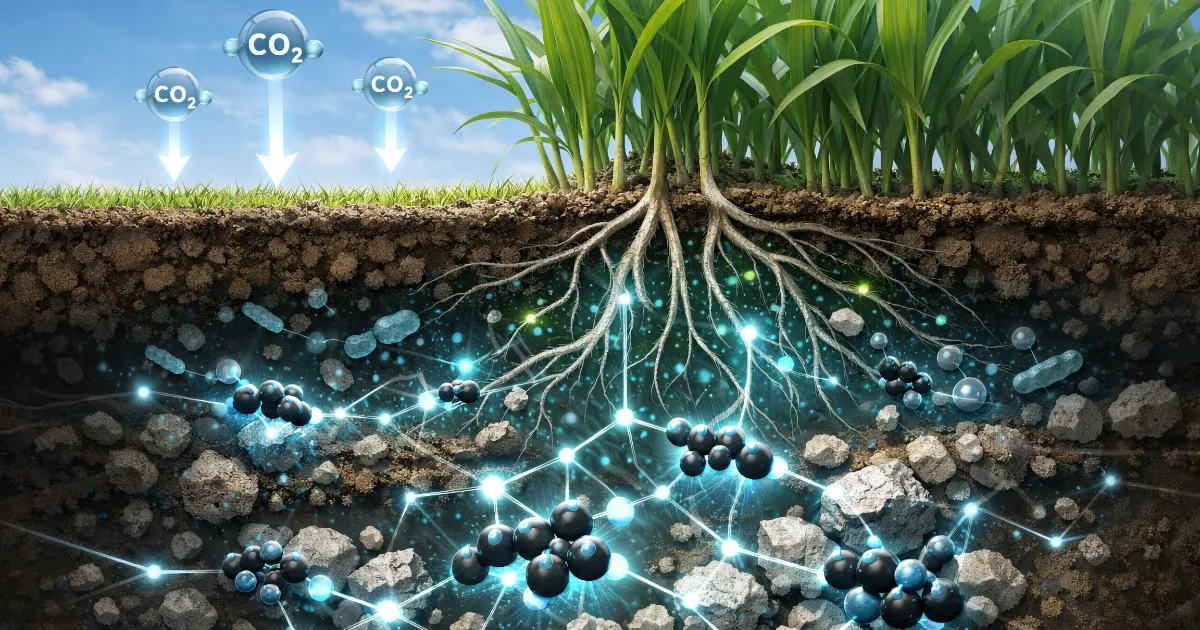
MAOC Stability is often misunderstood within corporate sustainability circles as a slow, multi-decadal process. At Dynamic Carbon Credits (DCC), we have dismantled this assumption through the Necromass Engine. By integrating high-rate microbial enhancement with a proprietary 144-day crop cycle, we deliver verified, 200 to 900-year carbon stability within a single growing season. This is the technical roadmap for achieving high-integrity carbon removal on an enterprise timeline.

Beyond Photosynthesis: The Speed of Permanence & MAOC Stability
Total MAOC Stability is achieved when carbon molecules move from the volatile state of plants into a chemical bond with soil minerals. At DCC, we force this transformation through a 144-day Biochar Agricultural Direct Air Capture (DAC-P) cycle. The plant serves as the fuel, but the Necromass Engine is the biological reactor that secures the asset for centuries.
In traditional carbon markets, "durability" is often synonymous with "slow." Forestry and conventional soil projects require decades of observation to verify sequestration. However, for a Fortune 500 company facing 2030 net-zero deadlines, the luxury of time does not exist.
The challenge of modern carbon removal (CDR) isn't just how much carbon we can capture; it is how quickly we can transition that carbon from a volatile biological state to a permanent mineral state. At DCC, we accomplish this through a 144-day Biochar Agricultural Direct Air Capture (DAC-P) cycle. The plant is the capture mechanism, but the Necromass Engine is the biological reactor that secures the asset.
The Death-Driven Pipeline: Understanding Microbial Necromass through MAOC Stability
Our engineering strategy centers on a fundamental shift in soil science: the recognition that the most stable carbon in the world does not come directly from plant biomass. It comes from dead microbes.
This is known as microbial necromass, and it is the primary precursor to Mineral-Associated Organic Carbon (MAOC). To maximize this, we have engineered a high-performance biological pipeline that forces carbon through three distinct phases of transformation.
1. The Microbial Accelerator (Phase 2 Enhancement)
Carbon stability is limited by the biological throughput of the soil. Passive systems wait for a healthy biome to evolve; we manufacture it. Through a proprietary compost tea inoculation, we increase microbial activity by 86% to 116%. This high-density population of bacteria and fungi creates a "biological vacuum," ready to receive and process carbon inputs the moment the crop is planted.
2. The High-Exudate Crop (144-Day Cycle)
We utilize a proprietary crop system designed for high-volume root exudation. These plants pump liquid sugars, organic acids, and proteins directly into the rhizosphere. This is "high-octane" feed for our enhanced microbial population. By forcing the plant to "leak" carbon into the soil, we fuel a hyper-active microbial life cycle.
3. Necromass Shielding (The MAOC Event)
As these microbes rapidly live, reproduce, and die, their cellular remains undergo a chemical transformation. Unlike plant stalks, which are vulnerable to decomposition, microbial remains have a high chemical affinity for clay minerals.
Through ligand exchange and cation bridging, these organic molecules form a covalent-like bond with soil particles. This process creates a "molecular shield" around the carbon atom, effectively isolating it from atmospheric interaction for centuries. This is the MAOC Advantage in action: the rapid conversion of volatile plant carbon into a stable geological asset.
Biochar: The Permanent Lattice
The Necromass Engine requires a foundation. We apply 35 tons of biochar per acre, creating a permanent physical framework within the soil.
From an engineering perspective, biochar serves two critical functions that simple soil management cannot replicate:
- The Bonding Scaffold: Biochar’s porous, high-surface-area structure acts as a "magnetic" lattice where microbes and minerals meet. It provides the physical protection necessary for necromass to bond with minerals without being consumed by scavenging organisms.
- The 900-Year Baseline: While our 144-day crops continue to "pump" new carbon into the soil, the biochar—certified by Puro.earth—serves as a high-density carbon sink with a verified lifespan of 500 to 5,000 years. This ensures that even the "baseline" of a DCC credit exceeds the permanence requirements of the most stringent corporate auditors.
Data substantiated: The 159% Growth Rate
Passive carbon sequestration is statistical guesswork; biological engineering is verifiable fact. Our five-year data set (2019-2024) reveals the true efficiency of the Necromass Engine. By actively managing the microbial cycle, we have achieved results that traditional agricultural methods cannot achieve in half a century:
159% Increase in MAOC Stock: Growing from 1,047 to 2,713 t CO2e/acre in stable mineral-associated pools.
- 64.9% MAOC Fraction: The industry average for agricultural soil rests between 30% and 40%. Our engine has nearly doubled this capacity.
- 218-Year Stability: Verified by radiocarbon dating at ISO 17025 accredited laboratories (Beta Analytic).
The math of carbon permanence is straightforward: Capturing Carbon = Holding Carbon. The Necromass Engine ensures that every ton removed is a ton permanently retired from the atmosphere's ledger.
Carbon at the Speed of Industry
The integration of 144-day crop cycles with microbial-mineral bonding proves that duration does not have to be slow. For the sustainability leader, this translates into verifiable, high-permanence removal credits that align with quarterly ESG reporting and long-term net-zero goals.
In the final installment of the Permanence Protocol, Anna Jacobs will detail our national "Vertical Scaling" strategy and explain why 60-foot deep-soil verification is the new standard for corporate compliance.