
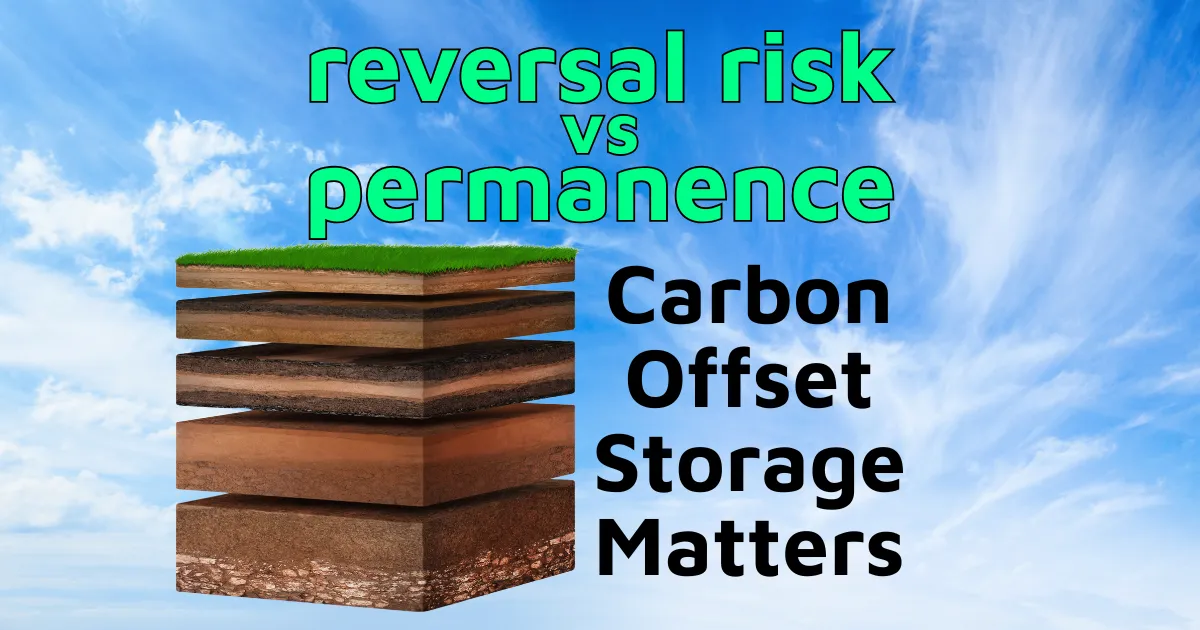
Carbon Credit Reversal Risk is the silent threat to corporate climate compliance. As global disclosure standards like California’s SB 253 and the EU’s CSRD come into force, the permanence of a carbon credit is no longer a marketing claim—it is a financial asset requirement. To eliminate this risk, sustainability leaders must move beyond surface-level soil carbon and embrace the 60-foot MAOC standard. Backed by DCC’s verified 64.9% MAOC results and 218-year average stability, this protocol provides the geological permanence required for long-term ESG reporting.

The Governance Challenge: Solving Carbon Credit Reversal Risk
For a Chief Sustainability Officer (CSO) at a Fortune 500 company, the most dangerous scenario is a reversal: the release of sequestered carbon back into the atmosphere due to environmental or management failure. This isn't just a greenwashing crisis; it is a regulatory failure that can force a company to restate its emissions ledger.
The core of this Carbon Credit Reversal Risk lies in a technical distinction most procurement teams miss: the difference between Particulate Organic Matter (POM) and Mineral-Associated Organic Carbon (MAOC).
The "Checking Account" Problem: Particulate Organic Matter (POM)
Most soil-based carbon credits are based on POM found in the top 12 inches of soil—decomposing plant debris, root fragments, and microbial waste. Think of POM as your carbon "Checking Account." While it is easy to deposit carbon here through standard regenerative practices, it is equally easy to "withdraw." A single change in farm management, a severe drought, or a heavy rainfall event can cause microbes to rapidly consume POM, releasing that stored carbon back into the atmosphere as CO2. For an audit committee, relying on POM is the equivalent of building a retirement fund out of high-volatility assets. According to the Intergovernmental Panel on Climate Change (IPCC), biological carbon pools are inherently volatile.
The "Savings Account" Solution: The MAOC Advantage
To eliminate reversal risk, CSOs must move their carbon "assets" from the checking account (POM) to a "Savings Account"—Mineral-Associated Organic Carbon (MAOC).
MAOC is carbon that has chemically bonded to clay and silt particles. These are not just "trapped" molecules; they are physically and chemically transformed. Through high-energy processes like ligand exchange and cation bridging, carbon atoms form a molecular "handshake" with the minerals in the soil.
Once bonded, this carbon is effectively "locked." It is protected from microbial decomposition for 50 to 1,000+ years. This is the MAOC Advantage: it provides the evidence of permanence required by auditors and the Science Based Targets initiative (SBTi).
The 60-Foot Standard: Achieving Geological Permanence
Reversal risk is highest at the surface. By utilizing a proprietary crop system with root structures designed to pump carbon deep into the Earth, DCC establishes a new 60-foot vertical standard.
While surface carbon is vulnerable to disturbance, our verification data shows that as you move deeper, the MAOC Advantage increases. At depths of 30-60 feet, DCC achieves 75% MAOC saturation. At this scale, carbon is no longer a biological byproduct; it is a deep-storage geological asset. We scale this nationally by targeting regions that meet our Mineral Shield Blueprint: high clay content (35-45%), smectite dominance, and deep vertical profiles.
Audit-Ready Verification: The DCC Ledger
General promises are insufficient for an audit committee. Dynamic Carbon Credits (DCC) provides site-specific, third-party verified data substantiated by isotopic Carbon-14 evidence:
- 64.9% MAOC Fraction: Nearly double the industry average of 30-40%.
- 218-Year Mean Residence Time: Verified by ISO 17025 accredited labs like Beta Analytic.
- 159% Increase in MAOC Stock: Growing your carbon "savings" from 1,047 to 2,713 t CO2
e/acre since 2019.
The companies that lead the 2030 net-zero transition will be those that prioritize scientific fact over marketing projections. By prioritizing the 60-foot MAOC standard, corporate leaders ensure their carbon retirement is verifiable, permanent, and—most importantly—audit-ready.
The DCC Benchmark: 218 Years of Verified Stability
At Dynamic Carbon Credits, we don't just "aim" for permanence; we measure it to a 60-foot depth. While the industry average for MAOC in agricultural soil sits between 30% and 40%, our 2024 testing results (verified by ISO 17025 accredited labs) demonstrate a paradigm shift:
- 64.9% MAOC Fraction: Nearly two-thirds of all carbon in our soil is in the permanently stable mineral-associated pool.
- 218-Year Mean Residence Time: Through radiocarbon dating (Carbon-14 analysis), we have proved that our carbon stays stored for over two centuries.
- Zero-Reversal Buffer: By targeting deep-soil smectite clays, we push carbon 30-60 feet underground—far beneath the "active" layer where surface-level disturbances can trigger a reversal.
Beau Parmenter, CEO of Dynamic Carbon Credits, frames it plainly: "The market is bifurcating. There are commodity credits with questionable impact, and then there are premium removal credits with a multi-century shield. For the Fortune 500, the choice isn't just about price—it's about the permanence of their legacy."
Audit-Ready Verification: Eliminating Carbon Credit Reversal Risk
As we look toward 2026, the scrutiny on "residual emission" offsets will only intensify. Audit committees will begin asking three specific questions of their CSOs:
- What percentage of our credits are POM vs. MAOC?
- Is the permanence verified by Carbon-14 dating or just computer models?
- Does our provider have a five-year documented track record of MAOC growth?
Dynamic Carbon Credits is built specifically to answer "Yes" to all three. Our five-year data set shows a 159% increase in MAOC stock since 2019, growing from a 1,047 t CO2e/acre baseline to 2,713 t CO2e/acre today.
Mitigate Your Reversal Risk Today
The transition to a net-zero economy requires more than good intentions; it requires rigorous, molecular-level carbon accounting. By prioritizing the MAOC Advantage, corporate leaders can move their climate strategies from the "checking account" of temporary sequestration to the "savings account" of permanent atmospheric removal.